Zero-friction EUDR compliance for global supply chains.
With local presence in Latin America, we bridge the gap between producers and importers in Europe. Clear customs with zero effort.
- Direct submission to the EU Information System
- Clear customs with a statement you can defend
- Full audit and traceability
- A trusted party between operators
- Ready for an inspection on any day
- Designed for absolute supply chain clarity
Integrated with the channels the EUDR relies on
- EU Information SystemDDS submission (TRACES)
- Copernicus Sentinel-210 m satellite imagery
- JRC Forest Cover 2020Forest map for the 2020 cutoff
- Global Forest WatchGLAD and RADD alerts
- Hansen Global Forest ChangeAnnual tree cover loss
Commodities
regulated by EUDR
Operators who place these goods, or products made from them, on the EU market, or export them, must show that they are deforestation-free, legally produced and covered by a due diligence statement.
Coffee
HS 0901
Green and roasted coffee, plus husks and skins.
- Geolocation of every plot where the coffee was grown
- Not grown on land deforested after 31 December 2020
- Harvest date or time range
- Produced legally under the laws of the producing country
Cocoa
HS 1801 to 1806
Cocoa beans, paste, butter, powder and chocolate.
- Geolocation of every plot where the cocoa was grown
- Chocolate and other cocoa products must be traced back to those plots
- Not grown on land deforested after 31 December 2020
- Produced legally: land use rights, labour and environmental law
Oil palm
HS 1511 and related headings
Palm oil and palm kernel oil, palm nuts and their derivatives.
- Geolocation of every plantation plot
- Palm oil and its derivatives must be traced back to the plots where the fruit grew
- Not grown on land deforested after 31 December 2020
- Produced legally under the laws of the producing country
Rubber
HS 4001, 4011 and related headings
Natural rubber and articles made from it, such as tyres.
- Geolocation of every plot where the rubber was tapped
- Tyres and other rubber articles must be traced back to those plots
- Not produced on land deforested after 31 December 2020
- Date or time range of production
- Country of production
Soya
HS 1201, 1208 10, 1507 and 2304
Soya beans, flour, oil and oilcake.
- Geolocation of every field
- Beans, flour, oil and oilcake must all be traced back to the fields
- Not grown on land deforested after 31 December 2020
- Produced legally, including land use rights and labour law
Wood
HS chapters 44, 47, 48, 49 and furniture
Timber, charcoal, pulp, paper, printed products and furniture.
- Geolocation of the area where the wood was harvested
- Common name and full scientific name of the tree species
- Harvested without forest degradation after 31 December 2020
- Harvest date or time range
- Country of production
Cattle
HS 0102, 0201, 0202, 0206, 4101, 4104 and 4107
Live cattle, beef, offal, hides and leather.
- Geolocation of every establishment where the animals were kept
- Meat, leather and other cattle products must be traced back to those establishments
- Not raised on land deforested after 31 December 2020
- Produced legally under the laws of the producing country
Product scope follows Annex I of Regulation (EU) 2023/1115, as amended.
What must you have to export under EUDR?
Businesses must capture, evaluate and keep this information to show compliance:
Geography & spatial data
- Geolocation mapping: GPS points and boundary polygons for every plot.
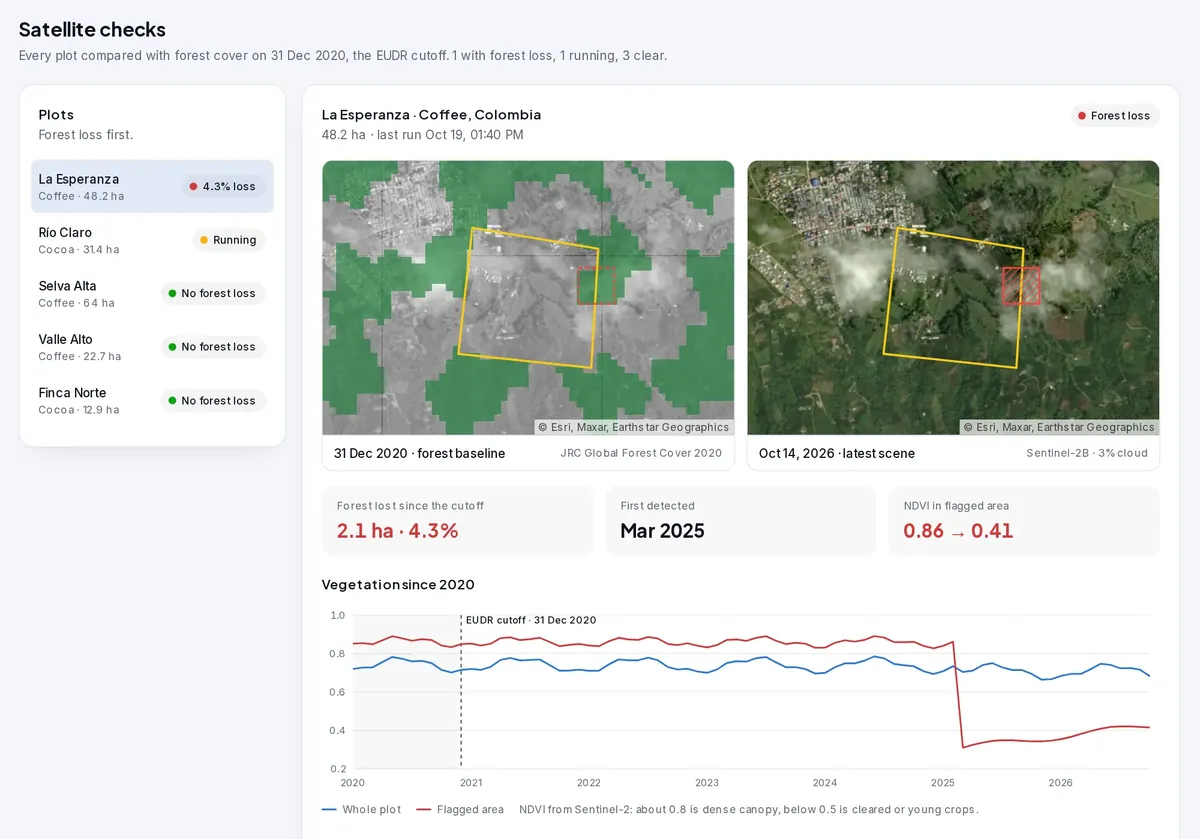
- Deforestation-free proof: Satellite evidence of no deforestation after 31 December 2020.
- Polygons above 4 ha: Plots larger than 4 hectares need a full boundary, not just a point. For cattle, the establishments are located instead.
- Supply chain traceability: Each shipment linked back to the plots and parties behind it.
Product specifications
- HS-coded description: Trade names, product types, net weight and identifiers.
- Party information: Names and contact details of suppliers and buyers.
- Species identification: Scientific species names alongside common names.
- Origin & timeframe: Production regions and harvest periods.
Legal & risk management
- Legality evidence: Land rights, labour law and environmental permits in the country of production.
- Country tiers: Risk evaluation aligned with the EU's low, standard and high benchmarking.
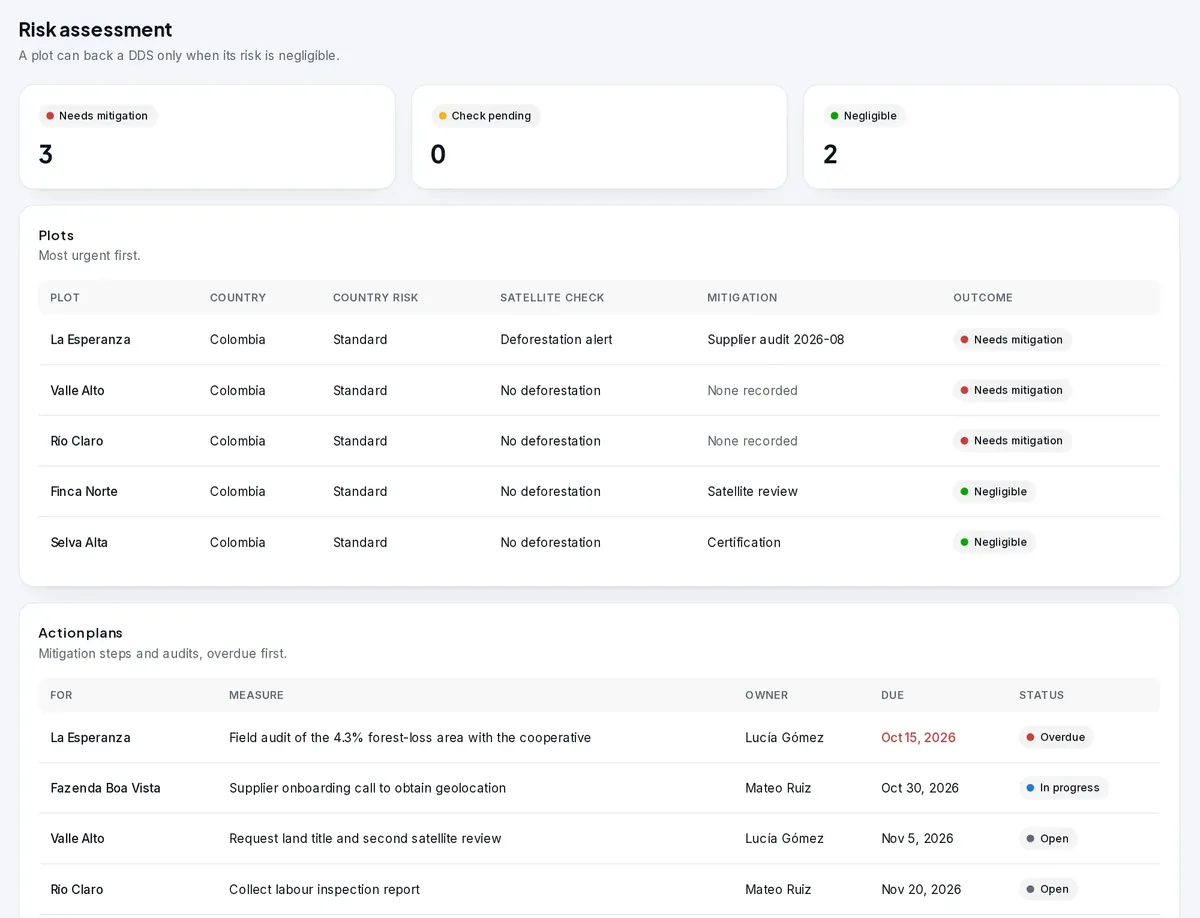
- Mitigation: Documented action plans and targeted audits when risk is not negligible.
- Record retention: Due diligence records kept for at least five years.
Built to remove friction and scale with you.
We work directly in the main production regions of Latin America, with European compliance, bridging producers and importers in Europe.
Clear for your team, ready for the authorities.
Everything an inspector will ask for, in one place.
Seamless compliance
From land mapping to action plans, every step of due diligence in one workflow.
Map every plot and import KML or GeoJSON files.
Compare each plot with forest-loss data from satellite imagery.
Turn risks into action plans with owners and due dates.
A trusted bridge
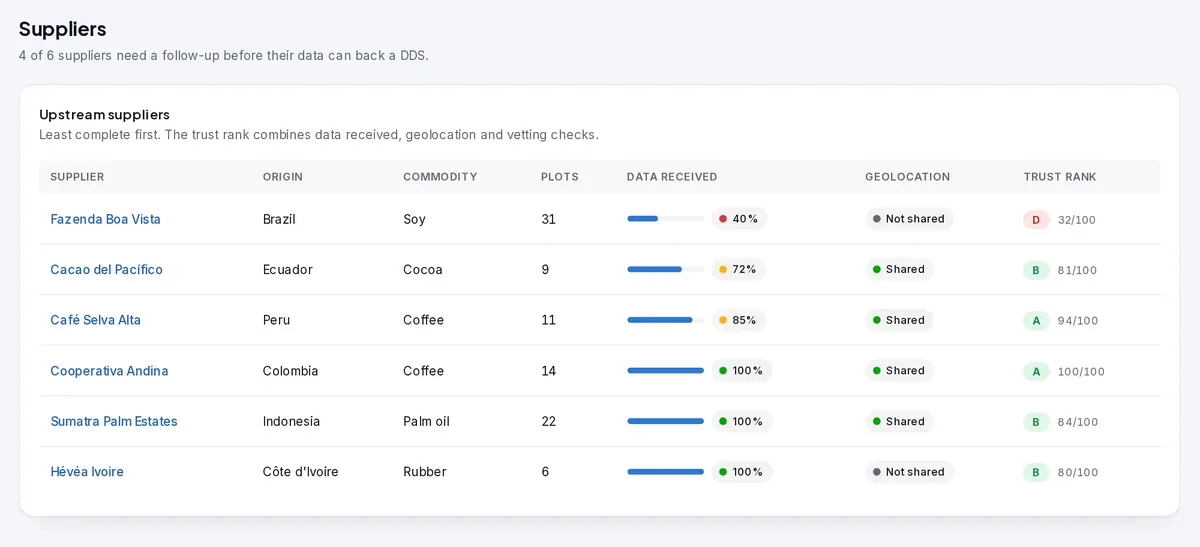
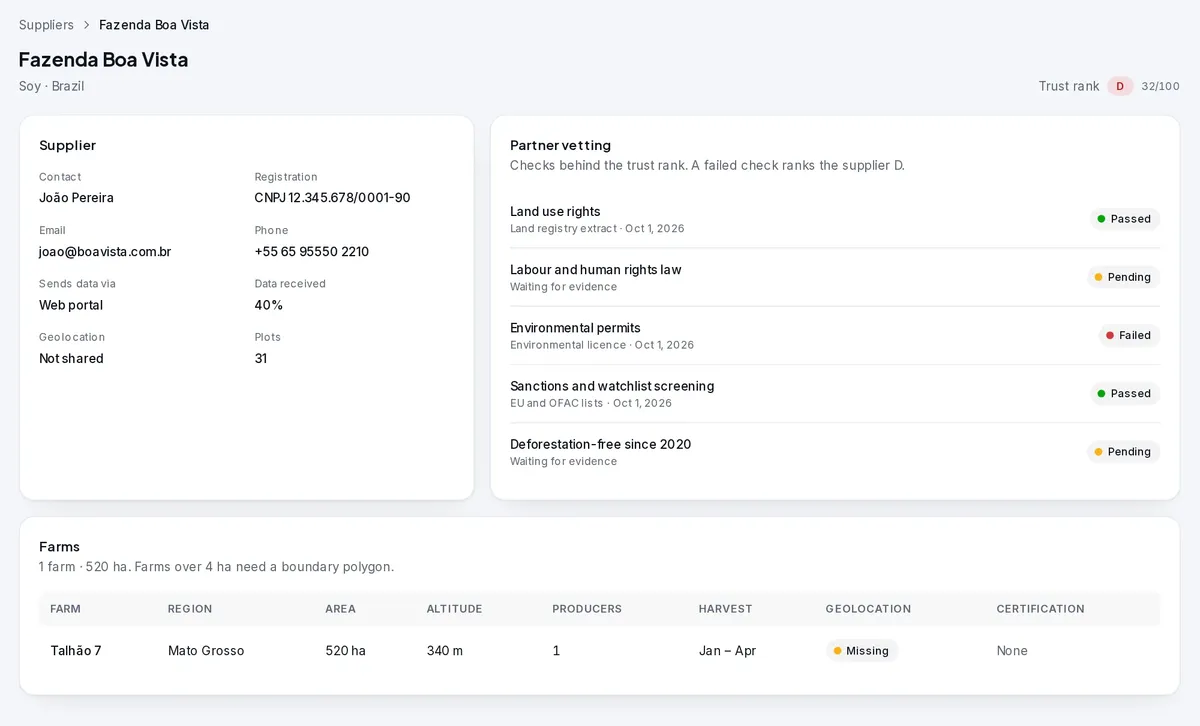
A trustee between producers and importers: everyone sees what is complete and what is still owed.
Producers choose who sees their plots, and can change it at any time.
Suppliers are ranked by the data they have provided, from A to D.
Importers see what is verified and what is still missing.
Evidence behind every statement
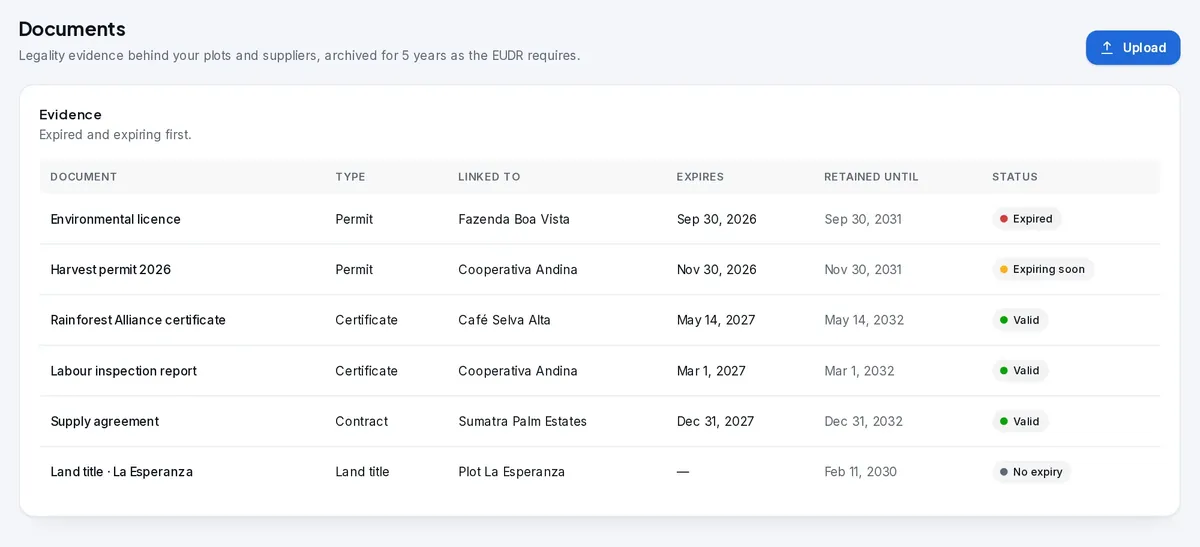
Everything an authority can ask for, already in one place.
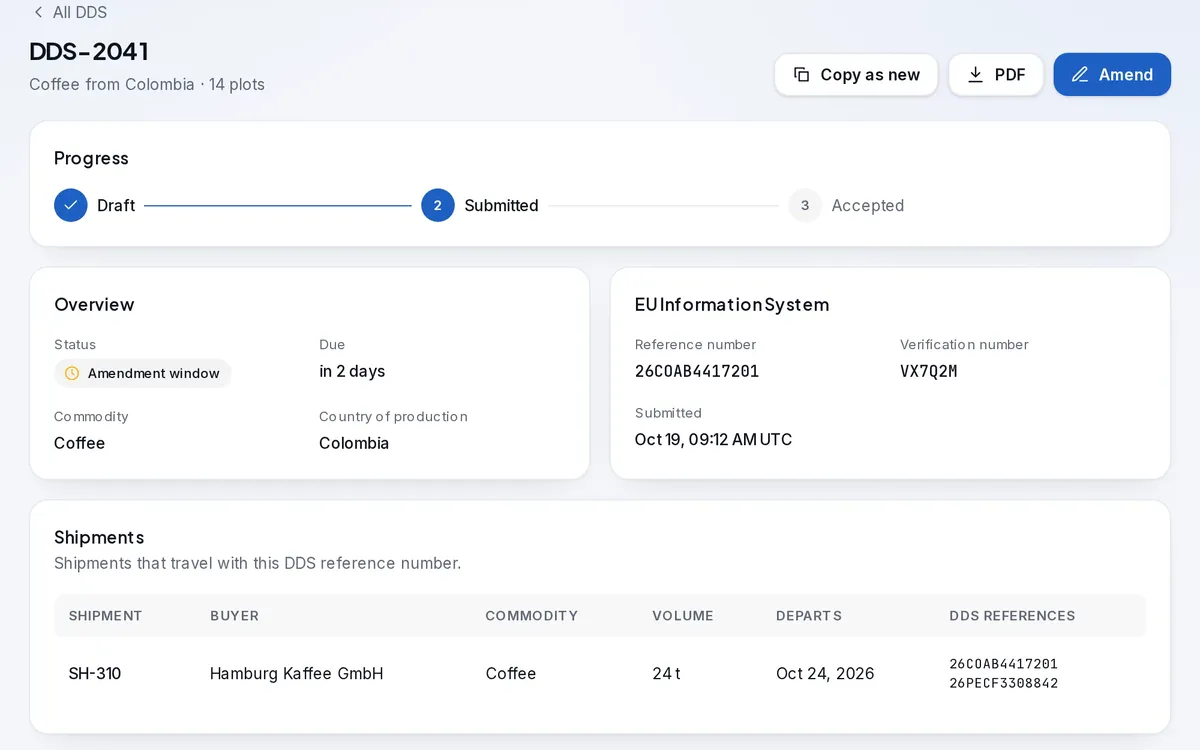
Each DDS links to its plots, satellite checks, documents and risk decisions.
Every import, edit, submission and authority reply is logged with who did it and when.
Records are archived for the five years the regulation requires.
Frequently asked questions
When does the EUDR apply?
Large and medium-sized operators must comply from 30 December 2026. Micro and small operators established by 31 December 2024 have until 30 June 2027, except for timber products already covered by the EU Timber Regulation, which follow 30 December 2026. Traders and downstream operators do not file their own statement, but they must keep traceability records. These dates have been amended twice already, so check the current text of the regulation.
Which products are covered?
Cattle, cocoa, coffee, oil palm, rubber, soya and wood, and products made from them, such as chocolate, furniture or printed paper, as listed in Annex I of the regulation.
Do I need a polygon for every plot?
Plots larger than 4 hectares need a full boundary polygon. Plots of 4 hectares or less can be declared with a single GPS point. This applies to every product except cattle, where the regulation asks for the location of the establishments where the animals were kept. AgroActs flags plots that are missing the geolocation the regulation asks for.
My producers don't use GIS software. How do they send plot data?
They can share a location pin, a KML file from any GPS app, or a document straight from WhatsApp. AgroActs files it against the right supplier and plot, and replies in their language.
Can AgroActs submit the Due Diligence Statement for us?
Yes. Under your mandate, AgroActs prepares the statement from your plots, products and risk assessment and submits it to the EU Information System on your behalf, then gives you the reference and verification numbers to pass downstream. Responsibility for the statement stays with you as the operator.
Who can see producers' geolocation data?
Upstream suppliers choose whether to share plot geolocation with their buyers. Every view, change and submission is recorded in the audit log, and records are kept for the five years the regulation requires.
Ready to simplify your EUDR compliance journey?
Talk to our team and see how AgroActs fits your supply chain, from the farm to the port.